
Healthcare environments
Calmer environments, for patients and for staff
We design the sound of waiting areas, arrivals and staff spaces, alongside acoustic treatment, isolation and layout. The brief starts with the people using each space and the way your facility operates.
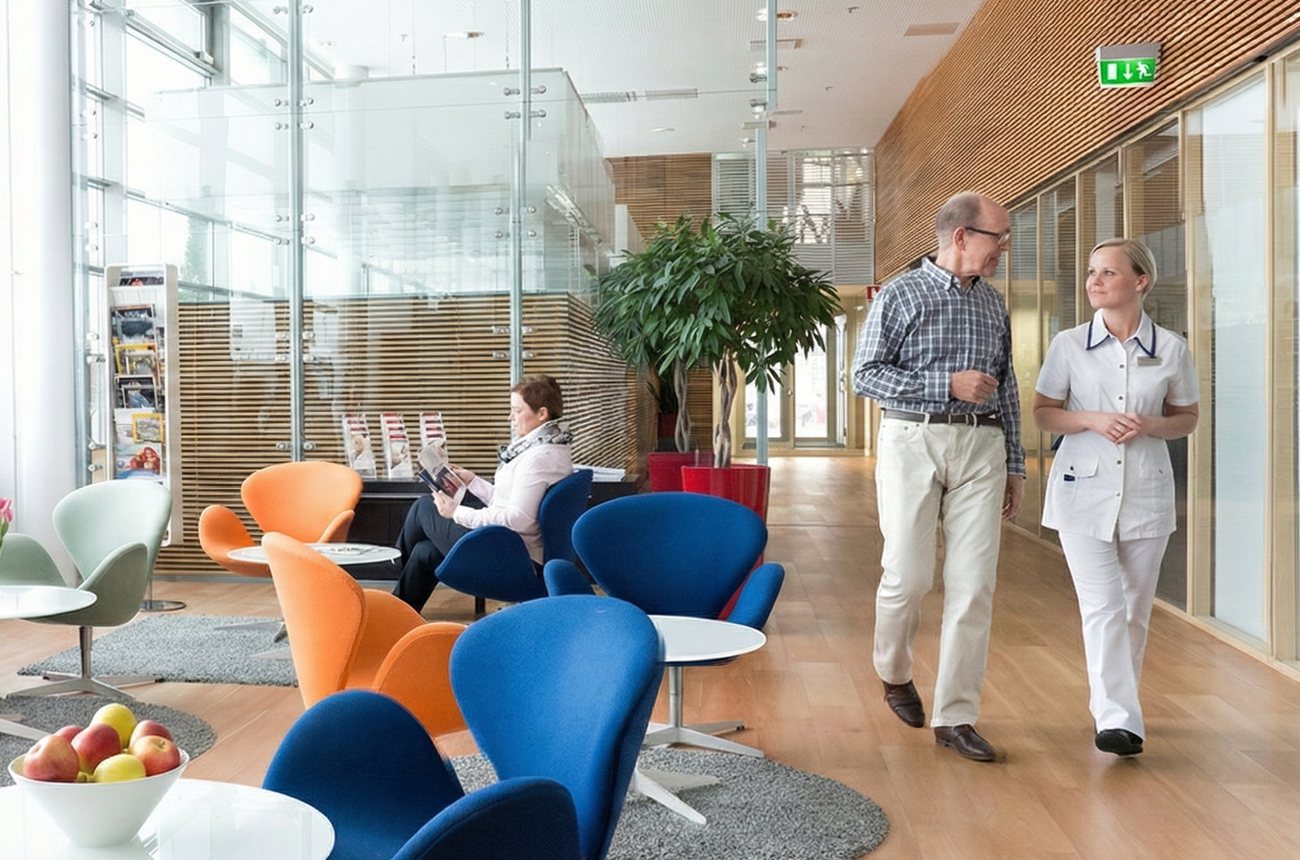
Waiting and arrival
Soundscapes designed to support acoustic comfort where people arrive, wait and step away.
Staff spaces
Break rooms and back-of-house areas considered separately from the clinical floor.
Occupied facilities
Assessment, installation and commissioning planned around clinical operations.
Our role
Design the environment.
Measure the difference.
We agree acoustic targets with your team, design for the spaces in your brief, and compare conditions before and after installation.
We have no installed project in a clinical facility. Our scope is a measured acoustic environment, not clinical outcomes.
Scent is considered only where appropriate to the people using the space, fragrance sensitivities and the facility’s policies.
The platform in healthcare
Moodsonic in clinical settings
Moodsonic, the platform we deliver, has also collaborated with Memorial Sloan Kettering Cancer Center’s innovation hub on a pilot in post-operative recovery rooms.
This is Moodsonic’s collaboration, not ours. The pilot account was published by its design team, not in a peer-reviewed journal; it does not establish clinical outcomes for your facility.
The platform in a hospital
Piloted at Memorial Sloan Kettering
Moodsonic, the platform we deliver, is the subject of a soundscaping collaboration with Memorial Sloan Kettering Cancer Center’s innovation hub, piloted in post-operative recovery rooms at the Josie Robertson Surgery Center in New York.
We state this precisely. It is Moodsonic’s collaboration rather than ours, and we make no claim here about clinical outcomes from it. What it tells you is the standard of scrutiny the platform invites: a leading cancer centre, working in live recovery rooms, treating sound as a designed element of care rather than a noise problem to suppress.
“By combining MSK’s world-class cancer care with Moodsonic’s audio expertise and unique soundscaping techniques, we aspire to create more novel audio experiences to help our patients feel and heal better.”
Daniel Stein, Senior Director and Chief Medical Informatics Officer, Memorial Sloan Kettering. From Moodsonic and MSK Innovation Hub’s published announcement of the collaboration; the collaboration is also listed on MSK Innovation Hub’s own site.
The pilot, as published
Three sounds, eight rooms, 1,758 patients
The design team behind the pilot has published an account of it, and because it is public we can report it, with its provenance stated plainly: this is a design team’s published account, not a peer-reviewed paper, and we treat it as exactly that.
The pilot ran for a year at the Josie Robertson Surgery Center, with eight months of data collection across eight identical outpatient post-operative recovery rooms and 1,758 patients, assigned to rooms at random. Two rooms carried adaptive biophilic soundscaping, two carried static white noise, and four carried no sound intervention, with discharge time, pain score and anti-nausea medication use tracked alongside more than 100 patient and staff surveys.
| As published | Adaptive soundscape | No intervention | Static white noise |
|---|---|---|---|
| Average discharge time | 186 minutes | 210 minutes | 282 minutes |
| Average pain score, 0 to 10 | 1.67 | 2.17 | 2.25 |
| Anti-nausea medication use | 19% | 24% | 28% |
The finding worth sitting with is the middle column against the last one. In this pilot, the rooms running static white noise did not merely underperform the soundscape. As published, they performed worse than the rooms with no sound at all, on every measure tracked: discharge 72 minutes slower than doing nothing, against the soundscape’s 24 minutes faster. In this pilot, as published, the static white noise rooms came last on every measure tracked. That is one pilot and one product configuration, not a finding about masking systems in general.
The qualitative results, as published: 91% of survey comments on the biophilic soundscaping were positive, and 90% of staff respondents supported the concept.
The limits, stated before anyone asks. One site, one pilot, one patient population, published by the design practice that built it rather than in a journal. It is not clinical evidence that soundscaping treats anything, and we will not use it that way. What it is: a named cancer centre, a randomised room assignment, three arms, and measured outcomes.
Source: the pilot design team’s published account at christopherbrause.com. The collaboration itself is documented by Moodsonic and MSK Innovation Hub. The platform is Moodsonic; the pilot is Moodsonic and MSK’s work, not ours.
Supporting your project
The research behind the brief
Research on sound and patient experience helps inform the discussion. Specific listening interventions and individual pilots do not establish the same outcomes for an installed building soundscape.
Acoustic design and measurement
Stated precisely
What we design, and what we measure
We have no installed project in a clinical facility. In healthcare we design the acoustic environment and measure it. We do not make claims about clinical outcomes, because that is not what we are engaged to deliver.
Where the evidence is strong
Acoustic conditions in healthcare buildings are well documented, and acoustic measurement before and after an installation is straightforward to carry out and report on.
What we design for
Perceived noise, speech privacy and acoustic comfort in the areas where people wait, recover and work, all of which can be measured before and after. We design to a target agreed with your team, not to a promise.
Our closest published example
Medibank's Wollongong workplace was designed for a health insurer's team. It is an office rather than a clinical facility, and we describe it that way.
Designed, not merely soothing
A 2025 study built nine soundscapes inside a real single-patient intensive care room at Erasmus Medical Center, over a measured background of air conditioning, monitor alarms and a ventilator, and rated them against ISO 12913. Ambiances designed to be pleasurable or stimulating significantly improved how the room was perceived. The ones designed to be comfortable and soothing made no significant difference at all. The design decision mattered more than whether the content was natural, which is the reverse of how this is usually sold.
Louwers, Pont, van der Heide et al. (2025), Applied Acoustics 241:110975. DOI 10.1016/j.apacoust.2025.110975
Clinical sound studies: findings, limitations and sources
The clinical literature, accurately
The strongest finding is the one about noise reduction
Healthcare is where the peer-reviewed evidence for designed sound is at its best, and it is also where it is most often overstated. Here is what the strongest studies actually concluded, including the parts that do not suit us.
What the research supports, and what it does not. Across the strongest studies, designed sound has reduced pain, improved sleep and lowered reported anxiety when compared with standard care and noise reduction. It has not been shown equal to music in critical care. A 2024 meta-analysis found no significant effect on perceived stress, and in participants who already had a health condition its pooled effect crossed zero. The six studies are set out in full below, including the parts that do not suit us.
The six studies in full, with their limits and their citations
Fifty-nine randomised controlled trials, eight databases, Cochrane methodology
A 2025 systematic review of sound and music interventions for intensive care patients, 37 music trials and 22 non-music sound trials, which is where nature sound sits. The finding, in the authors’ words: both can significantly “decrease pain; improve sleep; regulate cortisol levels; reduce sedative and analgesic need; and reduce stress/anxiety and improve relaxation when compared with standard care and noise reduction.”
That last clause is the one that matters. The comparison was against standard care and noise reduction, not against nothing. The review covers music and non-music sound interventions in intensive care rather than installed building soundscaping, so it is a reason to assess the sound layer rather than a finding about our work.
Papathanassoglou, Pant, Meghani et al. (2025), Australian Critical Care 38:101148. DOI 10.1016/j.aucc.2024.101148
And the part of it that does not suit us
The same authors immediately add that “compared to nonmusic sound interventions, there is more evidence that music interventions have an effect on stress biomarkers, vital signs, and haemodynamic measures”, and that more work is needed to establish whether non-music sound is equivalent. Nature sound is not proven equal to music in critical care, and we will not tell you it is.
Natural sound against a quiet room
A 2024 meta-analysis found natural sounds significantly outperformed quiet environments on heart rate (p = 0.006), blood pressure (p = 0.001) and respiratory rate (p = 0.032). It found no significant effect on mean arterial pressure, on oxygen saturation, or on perceived stress. Use it for physiological markers. Do not let anyone use it to claim people feel less stressed, that specific outcome was null.
One caveat inside the same paper, which we pass on because it is the one that matters here: in the subgroup of participants who already had a health condition, three studies, the pooled effect was −0.14 with a confidence interval from −0.37 to 0.10. That crosses zero. The strong result comes from healthy participants, not from patients.
Fan & Baharum (2024), Stress 27(1):2402519. DOI 10.1080/10253890.2024.2402519
Where the room can already be made quiet
A randomised trial across three Tehran teaching hospitals allocated 93 coronary care patients to nature sounds, to silence through mute headphones, or to routine care. Both interventions improved sleep quality against routine care. No statistically significant difference was detected between them: none of the differences between the nature sound and the silence groups reached significance, which is not the same as showing they are equivalent. Where a ward can genuinely be made quiet, quiet may be enough. Designed sound earns its place where quiet is not achievable, which in most working buildings is the honest position.
Nasari, Najafi Ghezeljeh & Haghani (2018), Nursing and Midwifery Studies 7(1):18. DOI 10.4103/nms.nms_39_17
An investigator-blinded trial finds no physiological effect
An investigator-blinded randomised trial of 100 adults, with a 30-person crossover replication, compared 30 minutes of forest soundscape against industrial sound. Mood improved. Perceived restoration improved on five of six measures. Cognitive performance improved. No significant differential effect was detected on heart rate, blood pressure, heart rate variability, salivary cortisol or immune markers. The null is in the paper’s own title. It was run on healthy young adults in a laboratory, so it does not settle the question for patients, but it is investigator-blinded with a crossover replication and it points the same way as the subgroup above.
Longman, Van Hedger, McEwan et al. (2025), Scientific Reports 15:33967. DOI 10.1038/s41598-025-11469-x
What we will not put in front of you
There is research in this field we could cite and have chosen not to. A 2024 meta-analysis reports large falls in blood pressure from natural sound. Its blood pressure finding rests on two studies, both of Iranian cardiac patients, one in a coronary care unit and one during coronary angiography, and the first of those reported no significant effect on physiological indicators in its own paper. It searched two databases. Its diastolic confidence interval runs from −24.96 to −2.99 mmHg. There are also trials on nature sound and recovery from coma. A company that sells building services has no business citing coma research.
Zhu, Yuan, Pan, Wang, Xiu & Liu (2024), Science of the Total Environment 921:171052. DOI 10.1016/j.scitotenv.2024.171052
None of this is a clinical claim about your facility. It is the state of the literature, reported as it stands. What we contract to deliver is a measured acoustic environment and a post-occupancy comparison of it.
Studied with patients
Nature sounds have been tested in clinical care
In a controlled study of 90 patients awaiting coronary artery bypass surgery, those who listened to nature sounds for 30 minutes reported significantly lower anxiety than patients wearing silent headphones. The difference was observed 30 minutes after listening and again before surgery the next morning.
In intensive care, a randomised trial of 60 patients receiving mechanical ventilation found lower anxiety, agitation, and systolic and diastolic blood pressure following a 90-minute nature-sound listening intervention.
During flexible bronchoscopy, a randomised trial of 80 patients found better reported pain control when nature imagery and sounds accompanied usual care. Anxiety did not significantly improve.
These studies support considering nature sound as part of the patient experience. They tested specific listening sessions or combined sensory interventions, so their results do not establish the same outcomes for every hospital soundscaping installation.
Sources
Amiri, Sadeghi & Negahban Bonabi (2017), Perioperative Medicine, nature sounds and anxiety before coronary artery bypass surgery. Saadatmand and colleagues (2013), International Journal of Nursing Studies, nature sounds, anxiety and agitation during mechanical ventilation. Diette and colleagues (2003), Chest 123(3):941–948, nature sights and sounds during flexible bronchoscopy. Fuller methods and limitations sit on the evidence page.
Scent in healthcare: findings, limitations and sources
And then scent
Scent and the waiting experience
Selected scents have been studied in healthcare waiting environments. In a cluster randomised trial of 340 dental patients, those waiting with lavender scent reported significantly lower immediate anxiety than those waiting without it. General dental anxiety, the kind a patient carries to the next appointment, did not significantly differ.
Results vary by scent and by setting. A separate study across three large dental clinics, with 219 patients, found no significant difference in anxiety, mood or reported pain from orange or apple scent. It was an attempt to replicate an earlier positive result and it did not.
For a healthcare project the first decision is whether scent belongs in the space at all. Any proposal has to account for the people using it, fragrance sensitivities and the facility’s own policies. The evidence supports careful consideration of selected scents in particular spaces, rather than a promise that fragrancing a building improves clinical outcomes.
Sources
Kritsidima, Newton & Asimakopoulou (2010), Community Dentistry and Oral Epidemiology 38(1):83–87, lavender scent and dental patient anxiety; cluster randomised, n=340. Toet, Smeets, van Dijk et al. (2010), Chemosensory Perception 3(3–4):182–189, ambient fragrance and dental fear; n=219 across three large clinics, no significant effect.
Send a floor plan and we come back with a zoning plan, where sound would help, and an indicative cost.
Hear it. Experience a soundscape in person. Get in touch to arrange a listening visit →